
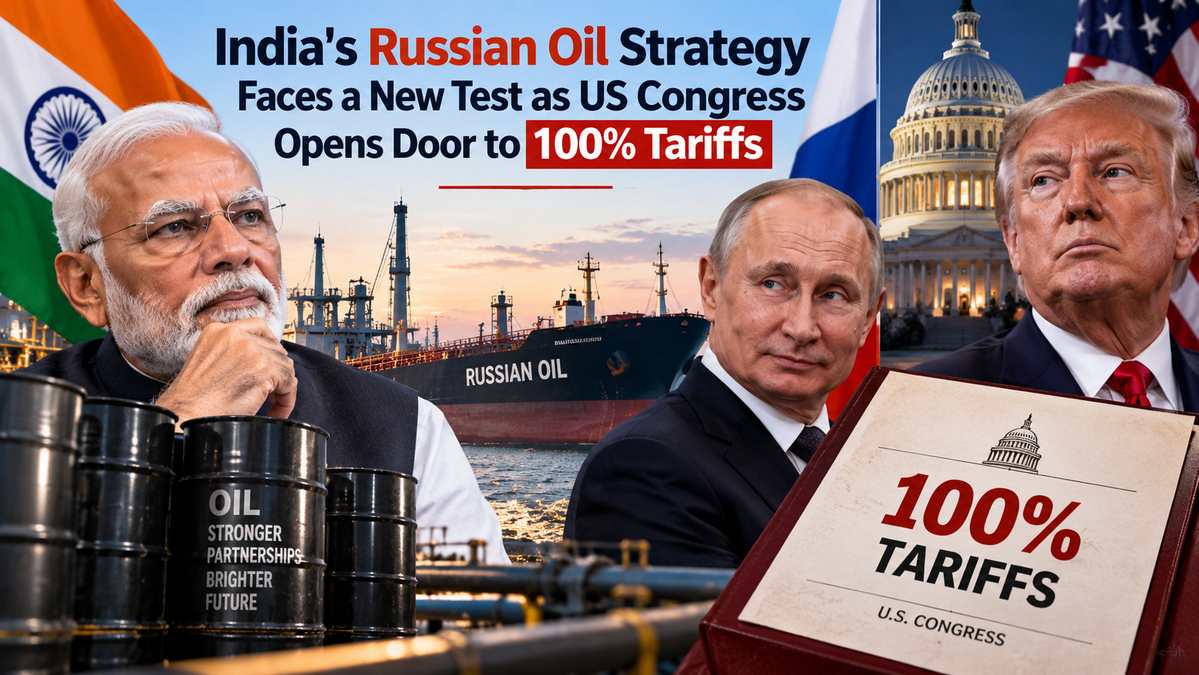
For years, Russian crude has given Indian refiners an important advantage: access to a large supply of oil that became available at attractive prices after Western sanctions reshaped global energy trade.
Now that advantage is becoming a much more complicated calculation.
The US House of Representatives has approved legislation that gives President Donald Trump the authority to impose tariffs of up to 100% on countries that continue to buy Russian oil and gas. India and China are among the major buyers potentially affected by the measure.
But there is an important distinction: the House vote does not automatically impose a 100% tariff on Indian goods. Instead, it creates a legal mechanism that could allow the US president to impose such tariffs. The bill now heads to the White House for Trump’s consideration.
For New Delhi, the issue is therefore bigger than oil.
It is becoming a three-way calculation involving energy security, access to the US market and India’s wider relationship with Russia.
What Did the US House Actually Approve?
The House passed the Lindsey O. Graham Sanctioning Russia and Iran Act of 2026 by a vote of 262-159 on September 16.
The Senate had already approved the legislation by 86-11 in August. The bill targets Russia’s financial and energy sectors and includes measures aimed at vessels associated with sanctions evasion, commonly described as Russia’s “shadow fleet.”
The legislation also gives the president authority to impose tariffs of up to 100% on major purchasers of Russian oil and gas.
That provision is particularly significant for India because the country has become one of Russia’s largest crude customers since the war in Ukraine transformed global oil flows.
A Tariff Threat Is Not the Same as a Tariff
This distinction matters.
India is not automatically being hit with a 100% US tariff simply because the House passed the bill.
The legislation would give the White House the authority to use tariffs against qualifying countries. Whether President Trump actually uses that authority, against which countries and at what rate would determine the eventual economic impact. The bill also contains provisions allowing presidential discretion in certain circumstances.
That leaves Indian policymakers facing uncertainty rather than an immediate new tariff.
And uncertainty can itself affect business decisions.
Indian exporters, refiners, banks and investors now have to consider what could happen if Washington chooses to use the new authority.
Why Is India’s Russian Oil Strategy Under Pressure?
Russia became a much more important crude supplier for India after Western restrictions disrupted Moscow’s traditional oil markets following the invasion of Ukraine in 2022.
Indian refiners were able to purchase Russian crude and process it into fuels for domestic and international markets.
According to figures cited by the BBC, Russian crude accounted for about 30.3% of India’s crude imports in fiscal 2026, worth roughly $40.8 billion. In July, Russia reportedly supplied more than half of India’s crude imports.
That is a substantial dependency.
It also explains why changing suppliers cannot simply be treated as a switch that can be flipped overnight.
India Has Alternatives, But They May Cost More
India does not rely exclusively on Russia.
The country purchases crude from producers across the Middle East and other regions, including Saudi Arabia, the United Arab Emirates, the United States and several Latin American suppliers.
But replacing Russian barrels on a large scale could increase costs.
Alternative crude may have different prices, transportation requirements and insurance costs. Shipping distances can also change depending on the supplier.
Indian refineries are additionally designed to process particular combinations of crude grades, meaning replacing one source with another is not always technically or commercially straightforward.
The BBC cited analysis indicating that India could replace Russian crude, but potentially at higher crude, freight and insurance costs.
That creates the central economic question for New Delhi:
How much is the discount on Russian oil worth if continuing to buy it creates a much larger risk for India’s exports to the United States?
The Pressure Works Through India’s Exports
There is another important detail that can easily be missed.
The proposed US tariff would not be a tax placed directly on Russian oil entering India.
The potential impact would be on Indian goods entering the US market.
That distinction changes the nature of the problem.
If Washington imposed a very high tariff, Indian exporters could face higher costs when selling products to American consumers. Industries ranging from electronics and pharmaceuticals to machinery, textiles, chemicals and petroleum products could potentially be affected depending on how the measures were implemented.
In other words, the pressure on India’s oil policy could arrive through its trade relationship with America.
The Timing Is Particularly Sensitive
The latest development comes while India and the United States are also dealing with broader trade negotiations.
That makes the Russian-oil issue more complicated than a standalone sanctions dispute.
A decision about crude purchases could influence negotiations over tariffs, market access and other commercial issues.
At the same time, India’s dependence on imported crude means energy policy cannot be separated easily from domestic economic priorities.
India imports more than 88% of its crude oil, according to figures cited by the BBC.
For a country of more than a billion people, energy security is therefore a strategic consideration, not simply a matter of refinery purchasing.
New Delhi Says Energy Security Remains the Priority
India’s government has indicated that it is monitoring developments and will take steps to protect its trade and economic interests.
The Ministry of External Affairs said India remains committed to ensuring energy security through diversified sourcing and changing market conditions. It also said the implications for the bilateral relationship and international energy markets had already been discussed with US interlocutors.
That language leaves room for India to adjust its sourcing without announcing a sudden break with Russian suppliers.
It also reflects the reality that India’s energy strategy has increasingly involved maintaining relationships with multiple suppliers rather than relying on one country.
Russia Still Matters to Indian Refineries
There is another layer to this story.
India does not simply consume all of the crude it imports.
Its large refining industry converts crude into products such as gasoline, diesel and other fuels. Some of those products are exported.
That means changes in the availability or price of Russian crude can affect refinery economics as well as India’s direct energy bill.
The BBC reported that Indian refineries supplied a large share of Russia’s oil-product imports in August, illustrating how the two countries’ energy relationship now operates in both directions.
This makes any rapid restructuring of the trade relationship more complicated.
China Faces the Same Pressure, but the Situation Is Different
India is not the only country in the spotlight.
China is an even larger buyer of Russian crude and is also potentially exposed to the new US sanctions framework. The BBC cited data showing China accounted for about half of Russia’s crude exports between December 2022 and August 2026, compared with 37% for India.
However, India’s economic relationship with the US has its own characteristics.
The United States is an important destination for Indian exports, making any major increase in US tariffs a significant concern for businesses that depend on American customers.
This creates a difficult balancing act.
The Bigger Question: How Much Flexibility Does India Have?
The latest US legislation effectively puts India’s energy strategy under a new form of pressure.
India can continue buying Russian crude if it remains commercially attractive.
It can increase purchases from other suppliers.
It can diversify further.
Or it can seek a negotiated arrangement with Washington.
Each option has economic and diplomatic consequences.
And the calculation can change quickly because oil prices themselves are constantly moving.
If Russian crude becomes significantly more expensive relative to alternatives, India’s incentive to buy it falls naturally. If the Russian discount widens, the economic argument for continued purchases becomes stronger.
The US tariff decision would add another variable to that equation.
The Oil Discount Is No Longer the Whole Story
The biggest change may be that Russian crude is no longer simply an energy bargain for India.
It now carries a potential geopolitical price.
For years, the basic calculation was relatively straightforward: cheaper Russian oil could help Indian refiners manage costs while diversifying global supply.
Now policymakers have to consider the potential cost of that strategy in another market — the United States.
A 100% tariff would be an extreme outcome, but the possibility itself creates uncertainty.
And uncertainty can influence investment, contracts, shipping arrangements and sourcing decisions before any tariff actually takes effect.
What Happens Next?
The immediate next step is at the White House.
The House has passed the legislation, following the Senate’s earlier approval, and the bill is now awaiting President Trump’s decision. If it becomes law, the question will shift from whether the president has the authority to whether, when and how that authority is used.
For India, the bigger challenge will be managing two essential relationships at the same time.
Russia remains an important source of crude.
The United States remains a major export market and economic partner.
That puts New Delhi in a difficult but familiar position: diversify energy supplies without creating unnecessary costs, protect access to important export markets, and preserve room for diplomatic negotiations.
The story, therefore, is not simply about a possible 100% tariff.
It is about how the global energy shock created by the Russia-Ukraine war is now feeding directly into India’s trade strategy.
The next decision from Washington could determine whether Russian crude remains a cost advantage for India — or becomes a much more expensive geopolitical calculation.