
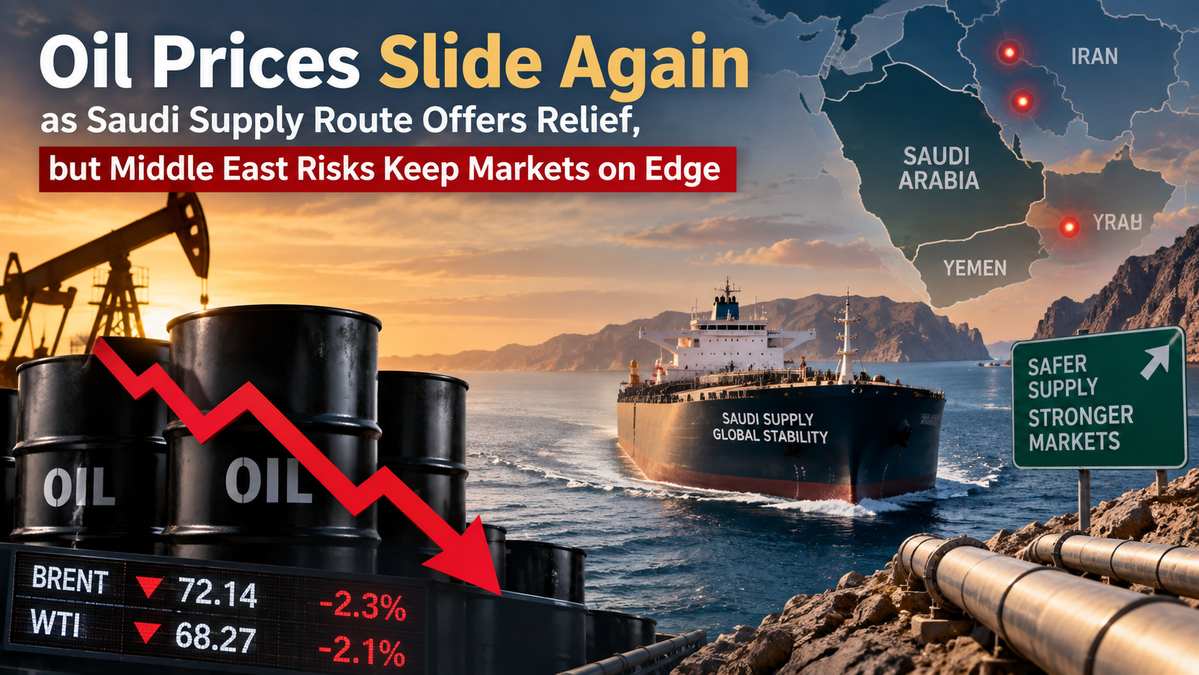
Oil prices extended their decline on Thursday as fresh signs of additional Saudi crude supplies eased some of the market’s immediate fears about a major disruption to Middle Eastern exports.
But the retreat should not be mistaken for a return to normal.
Brent crude futures fell $1.88, or 1.8%, to $103.95 a barrel by 0632 GMT, while U.S. West Texas Intermediate crude dropped $1.77, or 1.7%, to $100.66. Both benchmarks had already fallen by about $3 on Wednesday.
The important detail is that oil remains above $100 a barrel. That suggests traders may be less worried about an immediate shortage, but they are still pricing in a significant geopolitical risk.
Saudi Arabia Offers the Market Some Breathing Room
The latest pressure on oil prices came after reports that Saudi Arabia was offering additional crude cargoes through Oman.
The alternative supply route has helped reduce concerns that damage to Saudi oil infrastructure could quickly translate into a much larger loss of exports.
Saudi Arabia’s East-West pipeline, which carries crude toward the Red Sea port of Yanbu, has been affected by attacks. Offering additional cargoes through Oman provides refiners with another way to obtain Saudi crude while disruptions are being assessed.
For oil traders, that matters enormously.
Markets react not only to how much oil exists underground but also to whether producers can physically move it to buyers.
Why Prices Are Still Above $100
If supply fears are easing, why hasn’t oil fallen much further?
The answer is the broader conflict.
The Strait of Hormuz remains a major source of uncertainty. The waterway normally handles roughly one-fifth of global oil consumption, making any sustained disruption potentially significant for international energy markets.
Shipping data released Thursday showed that only three commercial vessels passed through the Strait of Hormuz on Wednesday, compared with 12 the previous day and a 10-day average of about 17. The figures may not include vessels that switched off their tracking systems.
That means the market is receiving two signals at the same time.
One says additional Saudi supplies could reduce the immediate shortage risk.
The other says the region’s key shipping routes remain severely disrupted.
That tension is keeping oil prices elevated.
Wednesday’s Drop Was Already Significant
The latest decline follows a sharp move lower on Wednesday.
Brent settled down $2.92, or 2.7%, at $105.83 a barrel, while WTI fell $3.40, or 3.2%, to $102.43. Reports of additional Saudi crude shipments through Oman were a major factor behind that move.
The market had previously been reacting strongly to attacks on energy infrastructure and concerns about shipping through the Gulf.
The shift shows how quickly oil prices can respond when traders receive evidence that some supply can still reach customers.
The Oil Market Is Watching Physical Supply, Not Just Headlines
One of the most important changes in the current market is the growing focus on physical oil flows.
When geopolitical tensions rise, traders initially react to the possibility of future shortages. But actual cargo movements can change that calculation.
If Saudi Arabia can continue supplying crude through alternative routes, some of the feared shortage may not materialize immediately.
That does not eliminate the risk. It simply changes its timing.
Think of it like a highway being blocked while traffic is redirected onto another road. The original route remains damaged, but the alternative prevents the entire transportation system from stopping.
For the oil market, Oman’s role as an alternative shipping route is providing some of that temporary relief.
But the Region Remains Highly Unstable
The supply picture remains vulnerable because the conflict is continuing.
Saudi Arabia has carried out strikes in Yemen, while Houthi forces have launched drones and missiles toward Saudi targets. Damage to Saudi energy infrastructure and disruptions around important maritime routes have increased concerns about the security of regional oil exports.
That makes the current decline different from a normal market correction.
Oil is falling because one part of the supply problem appears more manageable—not because the geopolitical threat has disappeared.
As long as attacks continue, traders have to consider the possibility that another facility, pipeline or shipping route could become a target.
The Strait of Hormuz Remains the Bigger Concern
For global energy markets, few locations matter more than the Strait of Hormuz.
Large volumes of crude and petroleum products normally pass through the narrow waterway connecting the Persian Gulf with the Gulf of Oman.
When shipping activity falls sharply, buyers and sellers have to consider longer routes, higher insurance costs and delays.
The latest tracking data showing only three commercial vessel transits on Wednesday therefore provides an important warning sign even as oil prices move lower.
The market is effectively balancing today’s available supply against tomorrow’s potential disruption.
Oil Prices Could Remain Extremely Sensitive to New Developments
The recent decline demonstrates how quickly prices can move when supply fears ease.
But the opposite is also true.
A new attack on energy infrastructure, a prolonged closure of an important shipping route or a significant reduction in crude exports could quickly reverse the market’s direction.
That sensitivity is one reason oil remains above $100 despite the latest losses.
Reuters reported that DBS Bank analysts see Brent potentially settling in a lower range if regional tensions ease, while a prolonged conflict could produce another sharp price spike.
Those scenarios underline the central uncertainty facing the market: whether the current disruption is temporary or the beginning of a longer-lasting restructuring of regional oil flows.
Falling Oil Prices Could Offer Some Relief Elsewhere
Lower crude prices can have effects well beyond oil traders.
If sustained, cheaper crude can reduce pressure on fuel costs for consumers and businesses and potentially ease some of the inflationary pressure created by the energy shock.
The financial markets have already reacted to the oil decline. European shares rose on Thursday, with travel stocks among the sectors benefiting from lower crude prices, while energy shares edged lower.
But a few days of falling prices are not enough to establish a new trend.
For businesses that depend heavily on fuel, transportation and energy, the bigger question is whether oil can remain below its recent highs.
The Bigger Story Is Supply Resilience
The latest oil-price move reveals something important about the global energy system.
Markets are not simply asking whether oil is available. They are asking whether it can be transported safely and reliably from producers to consumers.
Saudi Arabia’s ability to offer additional cargoes through Oman has temporarily reduced some of that anxiety.
Yet the sharp decline in shipping through the Strait of Hormuz shows how fragile the system remains.
That leaves the market caught between two competing forces: additional supply is limiting the immediate shock, while continuing regional violence is keeping the possibility of another disruption alive.
What Comes Next for Oil?
For now, oil traders appear to be taking some comfort from alternative Saudi supply routes and the possibility that the disruption to exports may be contained.
But the market has not returned to calm.
Brent remains above $100 a barrel, shipping through the Strait of Hormuz is severely reduced, and fighting continues across parts of the region.
The next major move in oil prices may therefore depend less on today’s trading charts and more on what happens to physical oil flows over the coming days.
If alternative supply routes continue to work and regional tensions ease, some of the geopolitical premium could disappear.
If another major energy facility or shipping route is disrupted, the market could quickly shift back toward shortage fears.
For now, the message from the oil market is straightforward: the immediate supply panic may be cooling, but the underlying risk has not gone away.