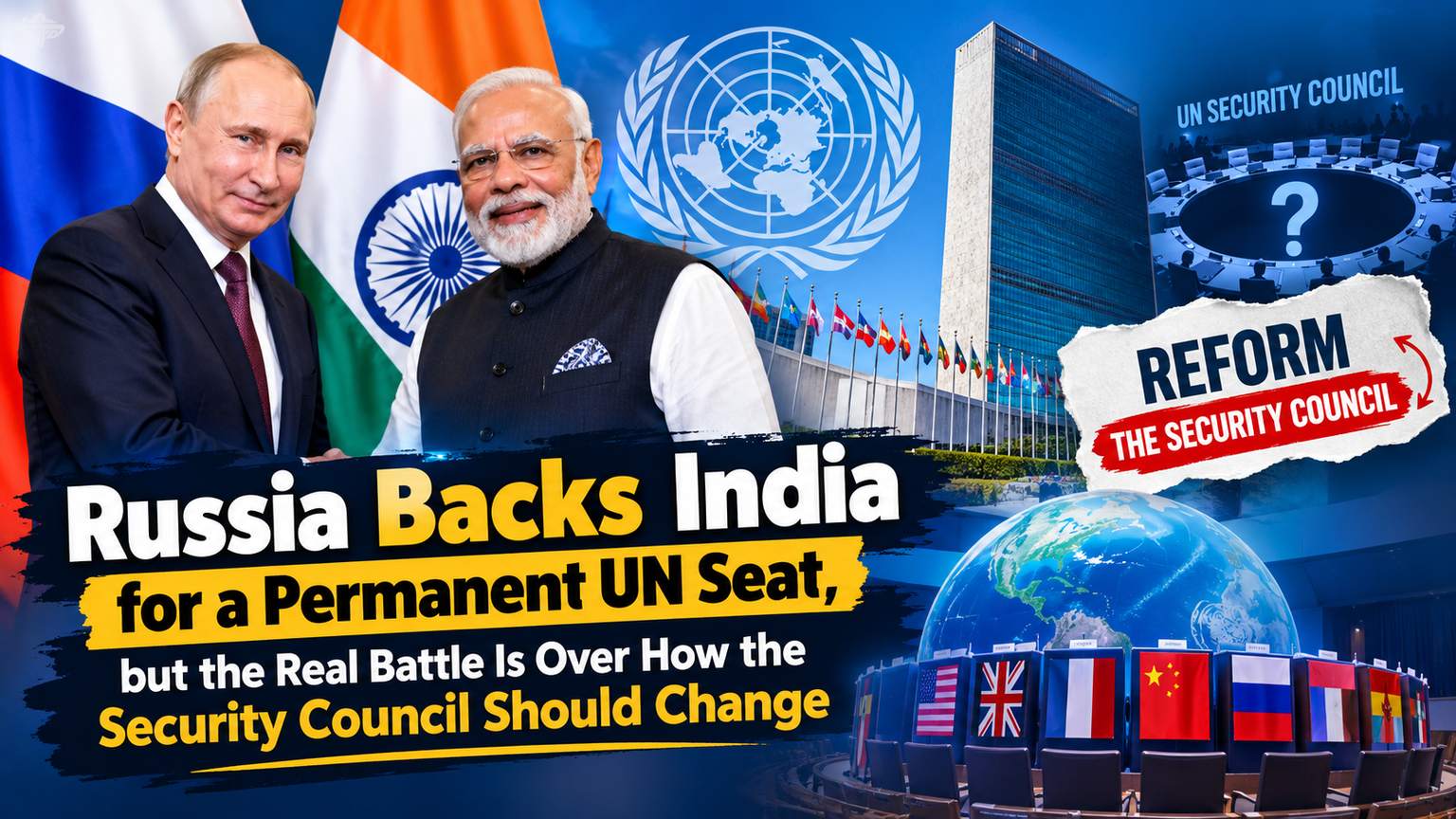
Russia has once again put its diplomatic weight behind India’s long-running campaign for a permanent seat on the United Nations Security Council.
Speaking during the 81st UN General Assembly in New York, Russian Foreign Minister Sergey Lavrov said Moscow supports the candidacies of India and Brazil for permanent membership. At the same time, he argued that Security Council reform should not create additional permanent seats for Western countries, specifically naming Germany and Japan.
Lavrov said Russia favors greater representation for Asia, Africa and Latin America, while also insisting that the existing permanent members retain their current prerogatives.
The statement gives New Delhi another prominent supporter.
But it does not mean India is about to receive a permanent seat.
The bigger story is actually about the competing visions of what a reformed Security Council should look like.
Russia’s Message Is About More Than India
Moscow’s position combines two separate arguments.
The first is straightforward: Russia supports India and Brazil for permanent membership.
The second is structural: Russia wants any expansion to give greater weight to the Global South rather than adding more permanent Western members.
Lavrov specifically objected to additional permanent seats for Germany and Japan, arguing that Security Council reform should focus on Asia, Africa and Latin America.
That means Moscow’s statement should not be interpreted simply as a bilateral endorsement of New Delhi.
It is also part of Russia’s broader argument about how global institutions should reflect the changing distribution of economic and political power.
India’s candidacy fits naturally into that argument because it would add another major Asian power to a body whose permanent membership was established in a very different international era.
India Wants a Seat at the Decision-Making Table
India has argued for years that the Security Council no longer adequately reflects today’s world.
The Council currently has 15 members: five permanent members — China, France, Russia, the United Kingdom and the United States — and 10 members elected for two-year terms.
India can win elected seats and participate in Council deliberations, but an elected seat is temporary.
A permanent seat would give India continuous representation and, depending on the eventual reform model, potentially the same institutional privileges enjoyed by today’s permanent members.
That distinction is at the heart of India’s campaign.
New Delhi argues that a country with a population of more than 1.4 billion, a major economy and an expanding role in international diplomacy should have a permanent place in the body responsible for some of the world’s most consequential security decisions.
But Permanent Membership Is Not an Election
This is where the process becomes much more complicated.
There is currently no vacant permanent seat waiting to be filled.
The UN Charter would have to be amended before India or any other country could become a new permanent member.
Under Article 108 of the UN Charter, amendments require adoption by a two-thirds majority of the General Assembly and ratification by two-thirds of UN members, including all five existing permanent members.
That gives every current permanent member a crucial role.
Russia’s support therefore matters.
So does the position of the United States.
So does France and the United Kingdom.
And most importantly, China’s position matters because Beijing is both a permanent member and India’s neighbor and strategic competitor.
A supportive statement from Moscow can strengthen India’s diplomatic campaign, but it cannot by itself change the UN Charter.
China Remains an Important Part of the Equation
The difficulty for India is that support for Security Council reform is not necessarily the same as support for India’s permanent membership.
China has supported a greater role for developing countries in global institutions but has not endorsed India’s permanent membership in the same unequivocal way as Russia and several other countries.
That makes the reform debate particularly complicated.
India needs a coalition broad enough to persuade countries across different regions while also dealing with disagreements among the five permanent members.
In other words, New Delhi is not campaigning for one country’s vote.
It is campaigning for a change to the architecture of the UN.
The Global South Argument Is Growing
Russia’s emphasis on Asia, Africa and Latin America is significant because calls for Security Council reform increasingly center on representation.
The existing permanent membership reflects the international power structure that emerged after World War II.
The world economy and geopolitical landscape have changed dramatically since then.
Countries such as India and Brazil have become major players in global affairs, while African states continue to argue that the continent deserves permanent representation.
The African question is especially important because the continent has no permanent seat despite being represented extensively in the UN’s wider membership.
Lavrov said Russia also wanted African interests addressed in any reform process.
That could become a central part of future negotiations.
India Is Not the Only Country Seeking a Permanent Seat
India is part of the G4 grouping with Brazil, Germany and Japan.
The four countries support each other’s campaigns for permanent membership.
That creates an interesting contradiction in the latest Russian statement.
Moscow supports India and Brazil but opposes permanent seats for Germany and Japan.
So Russia’s position aligns with only part of the G4’s collective agenda.
That does not invalidate Moscow’s support for India.
But it demonstrates why Security Council reform is so difficult: countries can agree that reform is necessary while disagreeing sharply over who should benefit from it.
Other Countries Are Also Backing India
Russia is not the only country to express support for India’s candidature during the latest UNGA session.
Mauritius reiterated its support for India’s permanent membership and said it backed the positions of the G4 and the L69 groupings on Security Council reform.
Portugal has also called for a more representative Council, including permanent representation for Africa, Brazil and India.
Several Central and Eastern European countries had also recently expressed support for India’s permanent membership during discussions with Indian External Affairs Minister S. Jaishankar.
These endorsements are useful because India’s campaign ultimately depends on building support across regions rather than relying only on the backing of major powers.
Why Russia’s Support Still Matters
Russia has been one of India’s longstanding diplomatic partners, and Moscow has repeatedly backed India’s aspiration for a permanent Security Council role.
That gives the latest statement continuity rather than representing a sudden policy change.
But the timing is still notable.
The latest endorsement comes as UN members are once again discussing whether the Security Council should be expanded and how representation should be distributed.
Russia’s argument gives India additional support in the debate over greater Global South representation.
It also reinforces a broader diplomatic narrative that the current structure should reflect today’s international system rather than the geopolitical realities of 1945.
The Hardest Question Is the Veto
Even if countries agree to add new permanent members, another difficult question remains:
Should the new members receive veto power?
The veto is one of the defining privileges of the existing five permanent members.
Any proposal that creates new permanent seats must therefore address whether new members would receive the same authority, receive a modified form of it, or have no veto at all.
Countries have different positions on this issue.
Some argue that new permanent members without veto power would create a second class of permanent membership.
Others worry that expanding veto rights could make an already difficult decision-making system even harder to operate.
India’s eventual place in a reformed Council will therefore depend not only on whether a new seat is created but also on what powers that seat carries.
Security Council Reform Has Been a Long Negotiation
The reform debate is hardly new.
The UN General Assembly has conducted intergovernmental negotiations on equitable representation and expansion of the Security Council for years. The UN says those discussions are aimed at finding a solution that can gain the widest possible political acceptance among member states.
That phrase — “widest possible political acceptance” — captures the problem.
There are many competing demands.
African countries want stronger permanent representation.
The G4 wants permanent seats for India, Brazil, Germany and Japan.
The L69 group has its own proposals involving developing countries.
The existing permanent members have different strategic interests.
And smaller countries have concerns about whether an expanded Council would actually become more representative or simply create another hierarchy.
India’s Challenge Is Turning Support Into Reform
This is where the latest Russian endorsement becomes most interesting.
India already has support from several influential countries.
The question is whether that support can be converted into a negotiated reform model.
That requires compromise.
India needs to maintain support from major powers while also working with African, Latin American, Asian and smaller states.
It also needs to navigate the fact that some countries support Security Council expansion but have different ideas about how many permanent seats should be created and whether new members should have veto rights.
Diplomacy, in this case, is less like winning a race and more like assembling a very complicated puzzle.
Every major piece has to fit before the picture changes.
What Russia’s Position Could Mean for India
The immediate impact of Moscow’s statement is diplomatic rather than institutional.
India now has another clear public endorsement from one of the five existing permanent members.
That strengthens New Delhi’s argument that its campaign has support beyond its immediate partners.
But it does not remove the biggest obstacles.
The Charter still has to be amended.
Two-thirds of UN members must approve the amendment and ratification must include all five existing permanent members.
And there is still no agreed final model for an expanded Security Council.
So India’s campaign remains a long-term diplomatic process.
A Changing UN, but No Easy Road Ahead
Russia’s latest statement captures the larger debate surrounding the Security Council.
Moscow wants greater representation for Asia, Africa and Latin America and explicitly supports India and Brazil.
Other countries are backing different combinations of candidates.
The G4 continues to campaign collectively.
African states are pressing for stronger representation.
And the five existing permanent members remain central to any final decision.
For India, the latest Russian endorsement is therefore another important piece of diplomatic support — but it is not the final breakthrough.
The real test will come when UN members move from speeches and endorsements to the much harder task of agreeing on the Council’s future structure.
That is where India’s permanent-seat campaign will face its biggest challenge.
The question is no longer simply whether more countries believe the Security Council should change.
It is what that new Security Council should actually look like — and whether the world’s major powers can agree on it.