
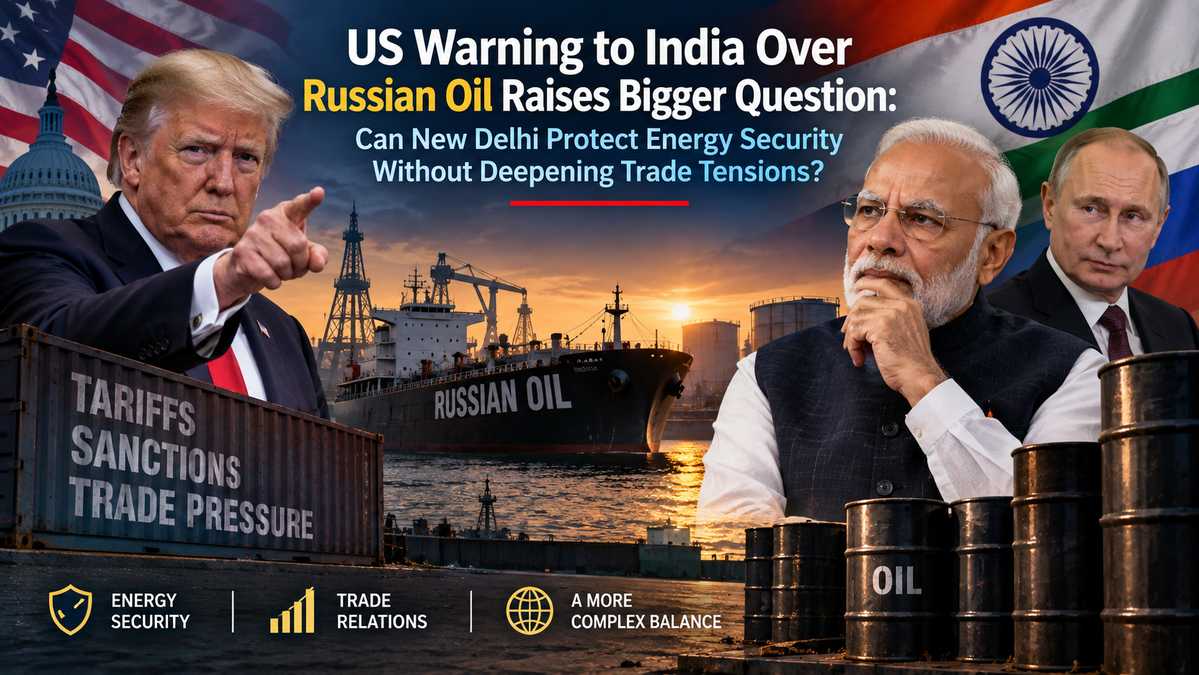
A blunt warning from Washington has put India’s Russian oil purchases under a brighter spotlight.
“Clean up your act” was the message from US Senator Richard Blumenthal to India and China after the US House of Representatives approved a sweeping Russia sanctions bill. He urged both countries to buy their oil and gas elsewhere, arguing that continued purchases of Russian energy help sustain Moscow’s revenues.
But behind the sharp political language is a much more complicated economic question.
India is one of the world’s biggest oil importers. Russian crude has become an important part of its energy mix, partly because Indian refiners have been able to obtain it at commercially attractive prices.
Now Washington is preparing a much stronger tool to discourage that trade.
The question for New Delhi is no longer simply whether it can continue buying Russian oil. It is whether the economic benefit of that oil can justify the potential consequences for India’s trade relationship with the United States.
What the US House Actually Approved
The US House passed the Lindsey O. Graham Sanctioning Russia and Iran Act of 2026 by 262 votes to 159 on September 16.
The Senate had already passed the legislation by 86 votes to 11 in August.
The bill targets Russian officials, financial institutions, energy interests and the so-called “shadow fleet” of vessels accused of helping Russian oil move around Western sanctions. It also creates a mechanism allowing the US president to impose tariffs of up to 100% on major purchasers of Russian oil or natural gas.
The legislation now goes to President Donald Trump.
That distinction is crucial.
India has not automatically received a 100% US tariff because of the House vote. The bill would give Trump the authority to impose such tariffs if the relevant provisions are activated after the legislation becomes law.
Why India Is in Washington’s Crosshairs
The reason is straightforward: Russia has become a major supplier of crude to India.
Following Russia’s invasion of Ukraine in 2022 and the subsequent Western sanctions, Indian refiners increased their purchases of Russian oil. The trade offered India access to an additional source of crude while giving Russian producers a major market.
Washington argues that revenue from Russian energy exports helps Moscow sustain its war effort.
US lawmakers are therefore trying to increase the cost for countries that continue purchasing large amounts of Russian energy.
India, however, views the issue through a different lens.
For New Delhi, crude oil is not simply a foreign-policy commodity. It is an essential input for a huge economy that relies heavily on imported energy.
India’s Response: Energy Security Comes First
India’s Ministry of External Affairs said Thursday that New Delhi remains firmly committed to ensuring energy security for its population.
The ministry said India would continue sourcing supplies from diverse sellers based on changing market conditions.
It also said India had already raised concerns about the potential consequences of the US legislation with American officials and had made clear that it would take necessary measures to protect its trade and economic interests.
That response gives an important clue about India’s likely approach.
New Delhi is not presenting the issue as a simple choice between Russia and the United States.
Instead, it is emphasizing diversification.
Why Walking Away From Russian Oil Is Not Simple
India can buy crude from other countries.
But changing suppliers on a very large scale can affect refinery costs, transportation expenses, insurance and the final price of petroleum products.
Indian refiners have also already arranged some Russian oil supplies for September and October, according to sources cited by Reuters.
Refiners are reportedly seeking flexibility from Washington rather than an abrupt cutoff, including possible arrangements that would allow existing transactions to be completed and provide a controlled reduction in Russian purchases.
That suggests the industry is looking at the issue as a supply-chain problem as much as a diplomatic one.
Replacing millions of barrels is not like changing suppliers for an ordinary manufactured product.
Oil has to be sourced, transported, insured, refined and distributed.
The 100% Tariff Threat Works Through India’s Exports
There is another important part of the story.
The proposed US measure is not simply a tax on Russian crude entering India.
The potential penalty would come through tariffs on goods entering the United States.
That could make Indian products more expensive in the American market and create pressure across businesses that depend on US customers.
The result could be an unusual economic chain:
India buys Russian oil → Washington seeks to penalize Russian-oil buyers → potential US tariffs affect Indian exports → Indian businesses face higher costs in the US market.
That is why the dispute extends far beyond the energy sector.
Washington’s Message Is Also Aimed at China
India is not alone.
China is also one of the world’s largest purchasers of Russian crude and is directly in the sights of the new US sanctions strategy.
Senator Blumenthal specifically addressed both countries after the House vote, saying they should purchase oil and gas elsewhere.
US lawmakers supporting the legislation argue that making Russian energy less attractive to major buyers could reduce the revenues available to Moscow.
For India and China, however, the calculation involves domestic energy demand, refinery economics and broader national interests.
The Bigger Pressure Point Is India’s Trade Relationship With America
The timing makes the issue particularly sensitive.
India and the United States are already engaged in discussions over trade.
A new tariff threat linked to Russian oil could make those negotiations more difficult.
Reuters reported that Indian analysts see the legislation as a potential complication for the two countries’ trade talks. Indian Trade Minister Piyush Goyal is expected to meet US officials during the upcoming G20 trade ministers’ meeting.
That means the Russian-oil dispute could spill into negotiations covering a much wider range of goods and commercial issues.
India Has More Than One Option
The new pressure does not necessarily mean India has to make an immediate decision.
New Delhi has several possible routes.
It could increase purchases from Middle Eastern producers and other suppliers.
It could gradually reduce its dependence on Russian crude if the economics change.
It could seek exemptions or transition arrangements from Washington.
It could continue purchasing Russian oil while negotiating with the United States.
Or it could combine several of these approaches.
The final calculation will depend on the tariff decision, global crude prices, shipping costs, available supplies and the terms of any agreement between Washington and New Delhi.
The Oil Market Could Feel the Impact Too
This dispute is unfolding while global energy markets are already facing disruption from the wider Middle East crisis.
That creates an additional complication.
If India sharply reduces Russian purchases at the same time that other major supply routes are under pressure, competition for alternative crude could increase.
Indian refiners have warned that cutting Russian supplies could affect their margins and raise costs, particularly when international oil markets are already unsettled.
In other words, pressure intended to change India’s buying behavior could have consequences beyond India and Russia.
It could also influence global crude flows.
A New Phase in India’s Balancing Act
India has spent years maintaining relationships with major powers that do not always agree with each other.
Russia remains an important energy and defense partner.
The United States is a major economic and trade partner.
The current dispute puts those relationships closer to one another than before.
Russian oil may offer India an economic advantage, but continued purchases now carry a potential trade-policy cost.
At the same time, abandoning Russian supplies too quickly could create new energy and refinery challenges.
That is the balancing act New Delhi now faces.
What Happens Next?
The immediate focus is on the White House.
The House has approved the legislation, following the Senate’s earlier vote, but the potential 100% tariff is not automatically in force. President Trump would have to use the authority provided by the legislation.
Until that happens, there is still room for negotiation.
India’s government has already signaled that it will protect its energy, trade and economic interests while continuing to monitor developments.
The next phase could therefore involve diplomacy as much as sanctions.
The real story is bigger than Senator Blumenthal’s “clean up your act” warning.
It is about a rapidly changing global energy system in which a barrel of Russian oil can now affect not only refinery costs, but also tariffs, trade negotiations and relations between major powers.
For India, the challenge is to keep energy supplies reliable and affordable while navigating increasingly complicated pressure from Washington.
And the outcome may ultimately depend not on whether India can buy Russian oil, but on how much economic and diplomatic cost it is prepared to absorb to keep doing so.