
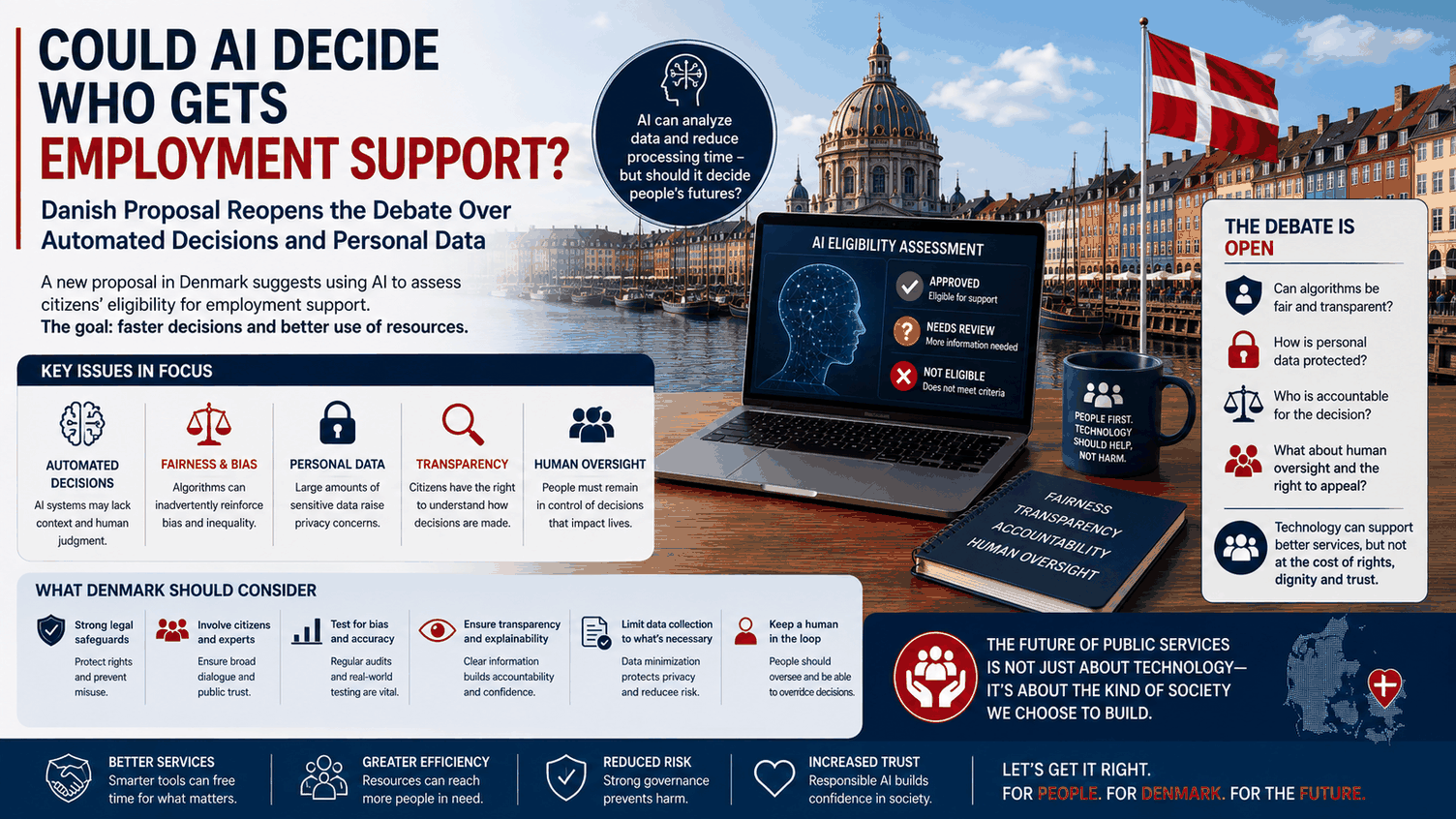
Denmark is considering expanding the legal foundation for artificial intelligence in its employment system, reopening an important debate over how far AI should be allowed to influence decisions involving jobseekers and their personal information.
A proposal published for consultation on August 10 would give Danish unemployment insurance funds, known as a-kasser, an explicit legal basis to process personal data using artificial intelligence as part of employment services.
The consultation closes at noon on September 7, 2026, and the proposal lists January 1, 2027 as the intended commencement date.
At first glance, the idea appears straightforward.
AI could potentially help employment organisations process information more efficiently, support caseworkers and provide jobseekers with more targeted assistance.
But employment services can involve large amounts of personal information and decisions with real consequences for individuals.
That creates a much bigger question.
When AI enters employment administration, where should the line be drawn between assisting a human decision and making the decision itself?
Denmark Is Already Bringing AI Into Employment Services
The new proposal does not appear in isolation.
Denmark has already been reforming its employment system with greater use of digital technology.
Earlier reforms gave municipalities and the Danish Agency for Labour Market and Recruitment a legal basis to use artificial intelligence to support parts of employment administration.
The Danish Ministry of Employment has described AI as one way of improving job matching and giving unemployed people better digital assistance with their job search.
The current proposal would address a gap involving unemployment insurance funds.
A-kasser perform important functions in Denmark’s employment system, but they are not public authorities in the conventional sense.
That distinction has created uncertainty about whether they have a sufficient legal basis to process personal information through AI systems when performing statutory employment-related tasks.
The August proposal is intended to address that uncertainty.
Why Do A-Kasser Want Clearer Rules?
The issue has been developing for some time.
During earlier consideration of Denmark’s employment reforms, unemployment insurance organisations raised concerns about being placed in a different legal position from municipalities.
They argued that a-kasser perform public-style functions when carrying out responsibilities assigned to them by law.
At the same time, some unemployment insurance funds have invested resources in AI and other digital systems intended to improve administration and services for members.
Without a clear legal foundation, they feared that data protection authorities could conclude that personal information could not be processed through certain AI systems when the funds were exercising these statutory functions.
That could limit how AI is used even where similar technology is available to municipalities.
The latest proposal attempts to create clearer legal authority.
But giving an organisation permission to use AI does not answer every question about how that technology should operate.
Personal Data Makes This More Than a Technology Story
The proposal sits directly at the intersection of employment law, artificial intelligence and GDPR.
Employment services can involve information about an individual’s work history, qualifications, unemployment, job-search activities and interactions with the employment system.
Depending on the particular service and dataset, other categories of personal information may also become relevant.
Once AI is used to analyse or process that information, familiar GDPR questions appear.
What information is actually necessary?
Why is it being processed?
How long will it be retained?
Who can access it?
Is information being combined from different sources?
Can the individual understand how the information is being used?
And perhaps most importantly, what influence does the AI output have on the eventual decision?
These are legal and governance questions, not simply technical ones.
The Development Matters Beyond A-Kasser
The debate is particularly relevant to businesses and organisations following employment and data-protection developments through Lead Roedl because similar questions are increasingly appearing in private workplaces.
Employers already use AI-supported tools for activities such as:
- Screening job applications
- Matching candidates with vacancies
- Assessing skills
- Managing work schedules
- Monitoring performance
- Analysing workforce information
- Supporting HR decisions
- Identifying employees for training or development
The exact legal rules depend on what the technology does.
But the underlying problem is similar to the one Denmark now faces with a-kasser.
Once an algorithm begins influencing decisions about people’s employment opportunities, the organisation needs to understand both the information being processed and the consequences of the system’s output.
Could AI Actually Make the Decision?
This is where GDPR becomes particularly important.
Article 22 of the GDPR provides protections concerning decisions based solely on automated processing that produce legal effects concerning a person or similarly significantly affect that person.
That does not mean every use of an algorithm is prohibited.
There is an important difference between an AI tool assisting a human caseworker and an automated system making a consequential decision without meaningful human involvement.
Imagine an AI system that reviews a jobseeker’s information and suggests vacancies.
That is different from a system automatically determining that a person should lose access to a benefit or opportunity.
The more significant the consequence, the more important questions around human oversight, transparency and legal safeguards become.
Organisations therefore need to understand what “human involvement” actually means in practice.
A person clicking “approve” on an AI recommendation without genuinely evaluating it may not provide the kind of meaningful oversight regulators expect.
AI Can Help Jobseekers Too
The debate should not be reduced to risks alone.
AI could provide genuine benefits in employment services.
Denmark’s broader employment reforms have already identified potential uses of AI for improving job matching and helping unemployed people search more effectively.
A traditional job-search system might depend heavily on exact keywords.
A more sophisticated AI system could potentially recognise related skills and occupations.
For example, a person with experience in one industry might possess transferable skills relevant to another industry even if the job titles are completely different.
AI could help identify those connections.
It could also potentially help caseworkers manage large amounts of information and spend more time on complex cases requiring human judgment.
The challenge is gaining those benefits without creating a system that individuals cannot understand or challenge.
Bias Remains a Serious Concern
AI systems learn patterns from data.
If the underlying data reflects historical inequalities, those patterns can potentially influence future recommendations.
This matters particularly in employment.
Suppose historical data shows that people of a certain age, gender or background were less frequently placed in particular occupations.
An AI model trained carelessly on those outcomes could learn to reproduce the pattern.
The system might appear neutral because a computer generated the recommendation.
But an automated recommendation is not necessarily an unbiased recommendation.
Organisations using AI therefore need to examine not only what information enters the system but also what outcomes the system produces.
Regular testing can be important for identifying unexpected discrimination or systematic disadvantages.
Sensitive Information Raises the Stakes
Some personal information receives additional protection under GDPR.
Special categories can include information revealing health, racial or ethnic origin, political opinions, religious beliefs, trade union membership and certain biometric information.
Employment-related systems can potentially encounter sensitive information.
For example, information about a person’s health may become relevant in some employment or benefit contexts.
That means organisations cannot assume that a general legal basis for processing ordinary personal information automatically resolves every data-protection question.
The categories of information being processed need to be understood.
AI systems are particularly challenging because they may identify patterns or make inferences from combinations of information that would not appear sensitive when viewed separately.
Transparency May Be One of the Hardest Problems
Most people understand a traditional conversation with a caseworker.
A jobseeker provides information. The caseworker reviews it and explains what happens next.
AI can make that relationship more complicated.
A person might not know that an algorithm has analysed their information.
Even if they know AI is being used, they may not understand what information influenced a recommendation.
This creates an important transparency problem.
Individuals should be given meaningful information about how their personal data is being used.
Simply stating that “AI may be used” may not always provide enough practical understanding.
Organisations may need to explain:
- What the AI system is used for
- What types of information it processes
- Where that information comes from
- Whether the AI makes recommendations or decisions
- What role a human caseworker plays
- How an individual can question an outcome
- Who is responsible for the processing
Clear communication can also improve trust.
People are more likely to accept technology they understand than a system that feels like an invisible decision-maker.
The EU AI Act Adds Another Layer
GDPR is not the only European law relevant to AI and employment.
The EU AI Act creates a risk-based framework for artificial intelligence.
Certain AI systems used in employment and worker management can fall into the high-risk category under the regulation.
Examples can include systems used for recruitment, selection, decisions affecting employment relationships, allocation of tasks based on individual characteristics and monitoring or evaluating workers.
High-risk classification can bring extensive obligations involving areas such as risk management, documentation, data governance, human oversight and monitoring.
Not every employment-related AI tool will automatically fall into the same category.
But businesses increasingly need to examine AI systems under more than one regulatory framework.
An organisation could have GDPR obligations because personal information is processed and separate AI Act obligations because of how the system is used.
Human Oversight Cannot Be Just a Checkbox
One of the central lessons for employers and public bodies is that human oversight needs to be meaningful.
An organisation might say that a human always makes the final decision.
But what happens if employees are trained to follow the AI recommendation almost automatically?
What happens if the system produces a score without explaining the factors behind it?
What happens if a caseworker has neither the authority nor the information necessary to disagree?
In those situations, nominal human involvement may provide less protection than it appears to.
Good governance should allow employees to understand an AI recommendation, question it and override it when appropriate.
The organisation should also know who is accountable when the system gets something wrong.
Employers Should Watch the Danish Debate
The proposed rules apply specifically to unemployment insurance funds, but private employers have good reason to follow the debate.
Many businesses are adopting AI faster than their internal policies are developing.
A department may start using a recruitment platform because it saves time without fully examining how candidate information is processed.
A manager might use generative AI to summarise employee information.
An HR platform may introduce AI-powered functionality through a software update.
Companies should therefore know which AI systems are being used across the organisation.
Useful questions include:
- Does the system process employee or applicant information?
- What data was used to train or configure it?
- Does it rank, score or recommend people?
- Could its output significantly affect an individual?
- Is sensitive information involved?
- Can employees understand the result?
- Is meaningful human review available?
- Can the decision be challenged?
- How long is personal information retained?
- Which external technology provider receives the data?
These questions can reveal risks before an automated system becomes embedded in everyday processes.
Denmark Now Has a Live Policy Question
The consultation remains open until September 7.
That means the exact framework is still being developed.
The proposal should therefore not be described as an enacted expansion of AI powers for unemployment insurance funds.
It is a legislative proposal currently being consulted on.
The intended commencement date is January 1, 2027.
What makes the debate significant is the direction it represents.
Denmark wants to use artificial intelligence to improve and modernise employment services. At the same time, employment administration deals directly with people’s livelihoods, opportunities and personal information.
Those two realities need to coexist.
The Bigger Question Is Who Remains in Control
Artificial intelligence can potentially make employment services faster and more useful.
It can help identify job opportunities, analyse information and support caseworkers handling large numbers of cases.
But efficiency cannot be the only measure of success.
People affected by AI-assisted employment systems need appropriate transparency and safeguards. Organisations need to understand their data responsibilities. Humans need to remain capable of questioning automated recommendations.
And when a consequential decision is made, responsibility cannot disappear inside an algorithm.
Denmark’s current proposal is therefore about more than whether unemployment insurance funds should be allowed to use AI.
It reflects a much broader question that employers, regulators and governments across Europe are increasingly being forced to answer:
How much decision-making power should we give machines when the decision can affect a person’s working life?
The answer is unlikely to be that AI should never be involved.
But as Denmark moves toward greater use of artificial intelligence in employment services, the legal challenge will be ensuring that technology remains a tool for human decision-making rather than an unexplained substitute for it.